
What Is Esthesioneuroblastoma (Olfactory Neuroblastoma)?
Traveling to Utah?
Let us help you navigate your visit.
COVID-19 Information
Find information about COVID-19 safety at U of U Health.
Esthesioneuroblastoma (ENB) is a kind of rare tumor found in the nose. It is also known as olfactory neuroblastoma because it grows in nerve cells in the nose and may affect your sense of smell. An esthesioneuroblastoma typically begins in the upper part of the nasal cavity, which is the open space behind and above the nose. It is considered a skull base tumor.
It is found in both adult men and women — at any age. However, it is relatively rare and only makes up about three to five percent of all tumors that occur inside the nose.
Is an Esthesioneuroblastoma or Olfactory Neuroblastoma Cancer?
Yes. The tumors are malignant (cancer).
Esthesioneuroblastoma Symptoms & Causes
Symptoms
Because the tumor grows in your nose, it can block your nasal passageways. As it grows, you may experience:
- reduced sense of smell,
- nosebleeds,
- congestion (sometimes on one side),
- sinus infections, and/or
- problems breathing through your nose.
If the tumor is not treated and spreads to other parts of your body—such as your sinuses, eyes, or brain—your symptoms may include:
- vision problems,
- headaches,
- seizures, and
- ear pain
The tumor is extremely slow growing and may cause symptoms for many months before it is properly diagnosed.
Causes
Scientists do not yet know the cause of esthesioneuroblastomas or olfactory neuroblastomas. It is possible that some inherited (genetic) problems may play a role in the disease.
Esthesioneuroblastoma Diagnosis
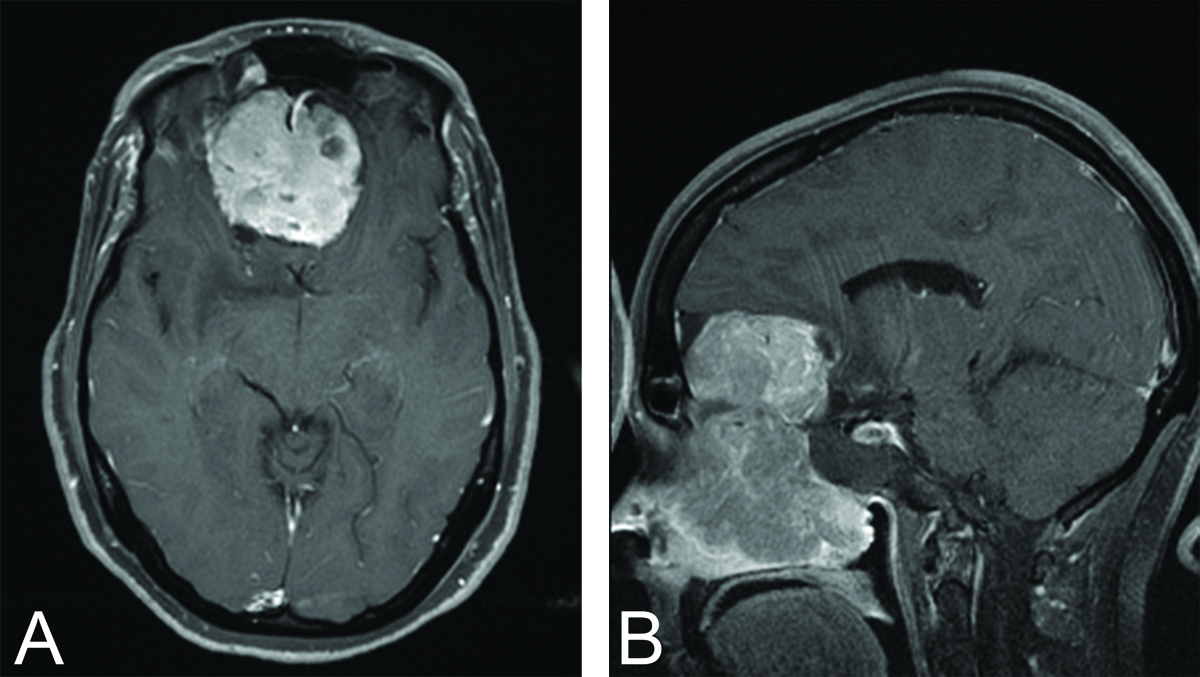
Top (a) and side (b) views, magnetic resonance images showing a sinonasal mass © 2015 Surgical Neurology International
Diagnosing an esthesioneuroblastoma (olfactory neuroblastoma) will begin with a general exam by your doctor to understand your symptoms. You will also need an endoscopic exam in your nose, imaging, and a biopsy.
Endoscopy
The specialist will place a thin tube with a camera at the end in your nose to see inside. That can confirm a tumor diagnosis and clarify how much the tumor has grown.
Imaging
Your doctor will recommend imaging, such as magnetic resonance imaging (MRI) and positron emission tomography (PET), to see the location of the tumor and the extent of its growth.
Biopsy
Your specialist may take out a piece of the tumor, which will allow them to examine it more closely. During the procedure, the doctor may place a small instrument in your nose to remove a sample.
Pathology
Viewing the piece of tumor under a microscope will help doctors know whether your tumor is an esthesioneuroblastoma. That will also show the tumor’s aggressiveness (or grade) and help doctors create a treatment plan.
Find a Specialist
Esthesioneuroblastoma Staging
Your doctor may describe your esthesioneuroblastoma with a letter from the Kadish Staging. In this system, the letters communicate where the tumor is located and how much it has spread.
Stage A— Tumor only in nasal cavity
Stage B— Tumor has spread to paranasal sinuses
Stage C— Tumor also found in areas beyond both nasal cavity and paranasal sinuses
Esthesioneuroblastoma Treatment
We remove most esthesioneuroblastomas with minimally invasive surgery or a craniotomy. In some cases, we may recommend radiation.
Surgery
Surgical advances have dramatically improved our ability to access and successfully remove your tumor.
Endoscopic Endonasal Surgery
The doctor will insert a long tube called an endoscope into your nose. The camera on the end will give the surgical team a better view of the tumor. Using microsurgical (very small) tools, the team will remove the esthesioneuroblastoma through the nose.
This approach will allow our surgeons to remove the entire tumor through the nose without making any external incisions. Once the tumor is removed, healthy tissue from elsewhere in your body may be placed in the area to restore it, if necessary.
Craniotomy
In some cases, surgeons will need to cut open your skull to reach the tumor. Doctors will make a slightly larger incision and temporarily remove a piece of skull bone. We will move aside a portion of the brain.
This helps us access the tumor and remove as much as possible. At the end of the procedure, our team will replace the skull bone.
This is a more invasive procedure and will typically require a longer hospital stay.
Non-Surgical Treatments
Even after surgery, your doctor may recommend additional radiation therapy at the Huntsman Cancer Institute to destroy cancer cells. When the cancer is advanced or there are other health challenges, we may recommend radiation rather than surgery.
The Huntsman Cancer Institute is part of University of Utah Health.
Stereotactic Radiation
We typically recommend stereotactic radiation, which we can tailor to your specific tumor or tumors. You may receive a single dose or multiple doses in an outpatient procedure (daytime visit).
Chemotherapy
Some esthesioneuroblastomas are also treated with chemotherapy. You will receive a series of anti-cancer drugs during multiple outpatient hospital visits (no overnight stays).
We are currently conducting more research into this method of treatment underway at University of Utah Health.
Esthesioneuroblastoma Survival Rate
Our ability to predict what these months of your life will be like (prognosis) will depend on:
- when the tumor is identified,
- the success of surgery, and
- the location of the tumor.
Younger patients may come through the surgery more successfully.
New, minimally invasive surgical techniques allow our surgeons to remove as much of the tumor as possible without damaging healthy issue.
A 2014 study in the Journal of American Medical Association (JAMA) Otolaryngology - Head and Neck Surgery examined the outcomes for 281 patients with esthesioneuroblastoma. Of that group, 61 percent of men and 70 percent of women had five-year survival. The survival rate at 10 years was 50 percent for men and 64 percent for women.
Researchers in the study concluded that an important indicator of survival rate was the grade of the esthesioneuroblastoma.
Preventing Nasal Cancer
People who smoke tobacco heavily or breathe in wood dust particles may have a higher risk of nasal cavity cancer.
Are Nasal Polyps Tumors?
Typically not. Nasal polyps (non-cancerous growths in your nose or sinuses) are extremely common and generally benign (non-cancerous).
Next Steps
If you believe you need an evaluation for a esthesioneuroblastoma, you can make an appointment with one of our skull base tumor specialists.
No doctor referral is necessary to come visit us, but please check with your insurance first as some insurance companies require referrals.
Get a Consultation
Not located in Utah? You can contact us for a consultation. Once we have scheduled the call, we will set up a phone call to discuss your diagnosis with you. We will also ask you to send us:
- Copy of the CD of your MRI images,
- Copy of your vision test, and
- Any other testing you may have had (endocrinology or other).